
Nashville Criminal History Checks
Nashville operates its own police department, but no single city search covers the full path from allegation to outcome. First decide whether the need is for the officer’s narrative, an active jail stay, a new court case, an older felony file, or statewide reportable history. Keep the report and case numbers as the search moves between offices.
- Contact Nashville Police for the city-created incident or arrest report and identify the event precisely.
- Use the village document center to select the correct incident-report or FOIA material and follow its stated submission route.
- Check the Barry County jail gateway and call 269-948-4804 if current custody is the question.
- Search D56B MiCOURT, then C05 when a felony docket shows bindover.
- Use ICHAT for broader public Michigan history, while confirming identity and disposition in the local file.
This order accounts for data-entry lag. A police report may exist before charges are authorized. A jail booking may appear before the first detailed docket entry. ICHAT may not reflect the newest local event and is not a live warrant or booking tool.
Nashville Police or Barry Sheriff?
The creating agency keeps the incident report. A call answered by Nashville Police belongs with the village department. A rural event handled by a Barry County deputy belongs with the Sheriff. A Michigan State Police response uses the MSP records channel. Location alone does not prove which agency authored the report, especially near the M-66 and M-79 corridors.
| Record Needed | Likely Keeper | Best Identifier |
|---|---|---|
| Village police narrative | Nashville Police Department | Incident number, date, location |
| County deputy report | Barry County Sheriff | Sheriff report number or event details |
| Current booking or release | Barry County Jail | Name and approximate booking date |
| Filed criminal case | 56B District or 5th Circuit Court | Complete case number or party name |
When the agency is uncertain, call the local office with the date, time, and exact place. Requesting from the right keeper is faster and reduces the chance of paying for a search that cannot locate the file.
Records at the Nashville Police Department
The official Nashville Police page names Chief Chris Underhile and publishes the direct department number, 517-852-9866.
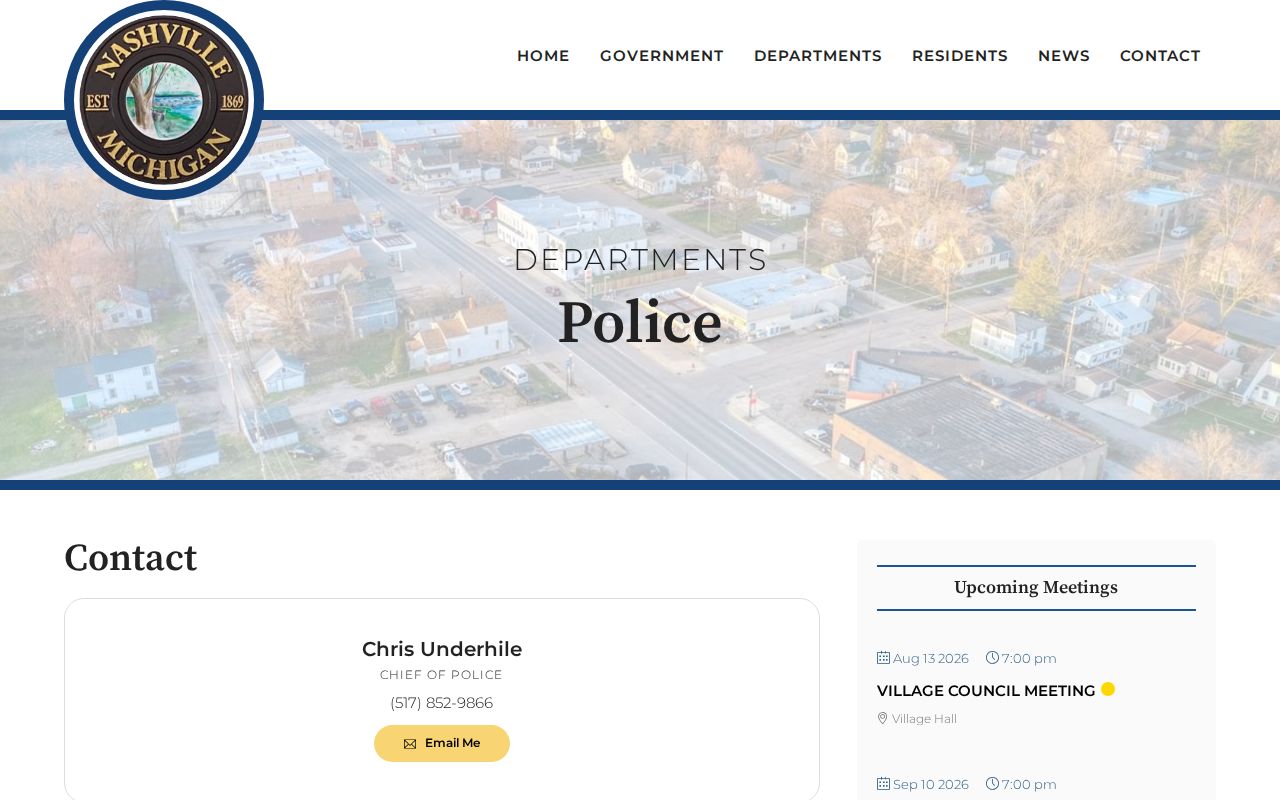
The village source confirms a distinct local department, which is why Nashville police reports do not default to the Sheriff records channel.
The department and Village Office are at 203 N. Main Street, P.O. Box 587, Nashville, MI 49073. Village telephone is 517-852-9544. Published office hours are Monday through Thursday, 8:30 a.m.–4:00 p.m. Ask for a specific existing report and include the incident number, date, location, names involved, and exact material needed. Do not infer an email destination from an unrelated village form.
Nashville Police Forms Explained
The official Nashville document center collects the village’s police and FOIA downloads.
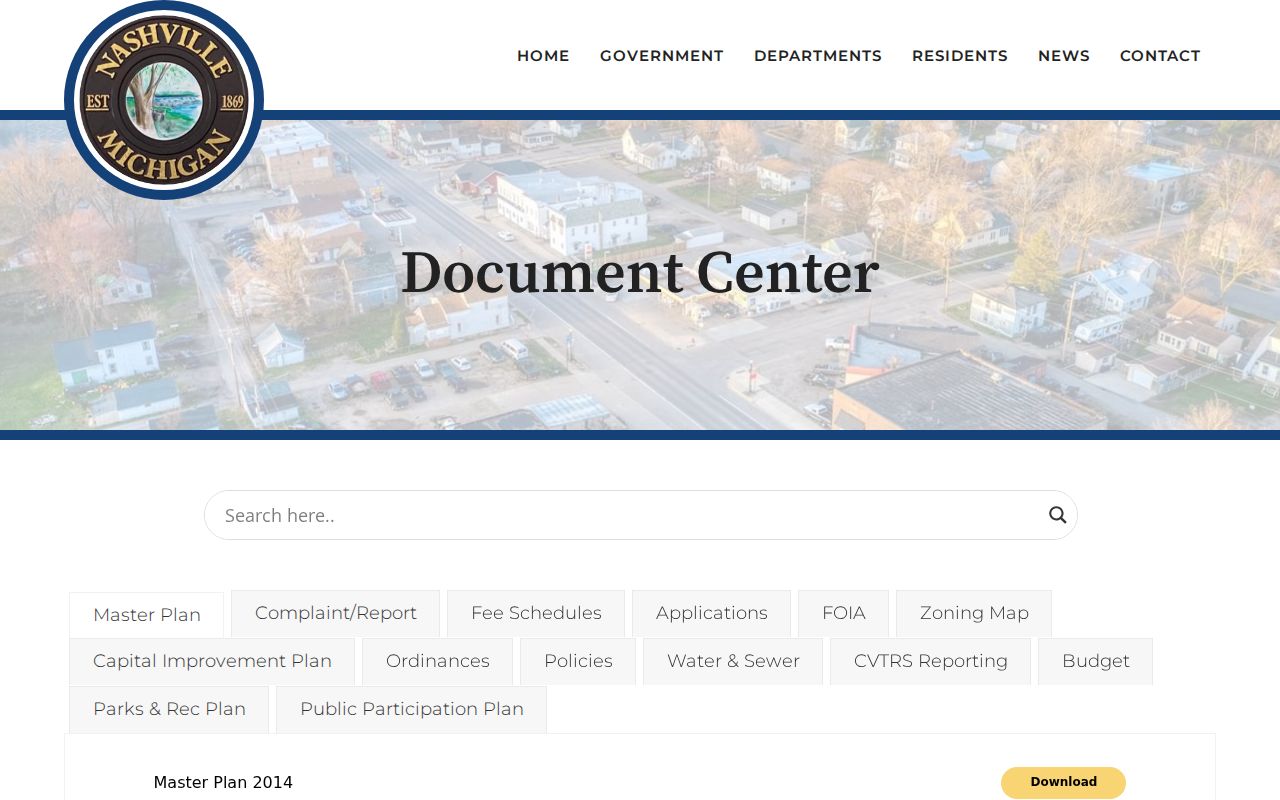
It is a download hub rather than a searchable police database, so the user still submits the selected document through the route printed on it or at the Village Office.
Available materials include a Complaint Against Police Officer form, General Complaint, Incident Report, FOIA Summary, FOIA Policy, FOIA Fee Schedule, general fee schedule, and ordinance-violation fee schedule. Select the form that matches the record. A request for an incident report is different from a complaint about officer conduct, and neither substitutes for a court-file request.
Booking and Arrest Records in Nashville
After a Nashville arrest, the person may be transported to the Barry County jail at 1212 W. State Street in Hastings. Booking normally includes identity intake, property inventory, fingerprints, booking photo, database checks, screening, charge entry, classification, and bond processing. The county’s inmate lookup gateway points to VINELink for custody status and notification.
VINELink is not a complete local arrest-history archive. Call the jail at 269-948-4804 for current custody. For an existing releasable booking sheet, charge and bond page, or release record, use the Sheriff records process. The Nashville Police narrative remains with the village even though the person is housed in a county facility.
Note: A Nashville arrest allegation and Barry jail entry must never be described as a conviction without the final court disposition.
When Nashville Offices Are Closed
The village’s public office hours end Thursday afternoon for the week. That schedule does not make the county FOIA coordinator the keeper of Nashville Police records. For an urgent current-custody question outside village hours, call the Barry jail. For a later report request, use the Nashville form and submission instructions when the office reopens.
New court activity may be checked through D56B MiCOURT, though same-hour events can lag. Emergency calls still belong through emergency dispatch, not a records request. A 911 audio or CAD log is held separately by Barry County Central Dispatch and may be requested through its FOIA page. Dispatch data is not the officer’s narrative.
The Nashville Municipal Court File
Nashville does not operate a separate municipal criminal court portal. Village ordinance and traffic matters, misdemeanors, adult arraignments, and felony preliminary proceedings route through the 56B District Court. A felony transferred after bindover proceeds in the 5th Circuit Court. Both records belong to the Barry County Trial Court system.
| Court Name | 56B District Court, followed by 5th Circuit Court for a bound-over felony |
|---|---|
| Case Types Heard | Ordinance and traffic matters, misdemeanors, arraignments, and felony preliminary stages |
| Case Lookup Channel | D56B MiCOURT; C05 MiCOURT after felony transfer; clerk request for record copies |
| What the Docket Shows | Case identification, charges, events, hearings, status, disposition, and available financial entries |
| Copies & Fees | Request an identified file by full case number or party name; staff calculates current copy costs |
Calling it a “Nashville municipal court file” describes the city connection, not a separate courthouse. The correct public search code for the first adult criminal stage is D56B.
Using D56B for Nashville Cases
Open the D56B MiCOURT search, enter the known name or case details, and verify the court code. A result may show the case number, filing date, type, judge, status, charge descriptions, statutes, hearing events, dispositions, and some financial entries. Read each charge separately because one count may be dismissed while another results in conviction.
MiCOURT is primarily an index. A register-of-actions entry does not ensure a free PDF. Barry Trial Court’s copy procedure requires a complete case number or party name tied to a specific case. Older or nondigitized material needs clerk contact. When D56B shows a felony bindover, use C05 MiCOURT for the circuit phase and final trial-level disposition.
Nashville Allegation to Disposition
The same event changes legal shape as it moves. Nashville Police documents allegations and evidence. Jail staff records custody and the intake charge. Prosecutors decide what to file. The court then records hearings and the result. ICHAT later presents a defined public statewide slice supported by reportable data.
Case flow: Police allegation › Barry booking › charging decision › D56B proceedings › C05 felony proceedings when applicable › final disposition.
- Arraignment
- The hearing where charges and rights are stated and a plea may be taken.
- Bindover
- The transfer of a felony case from District Court to Circuit Court.
- Disposition
- The outcome of a case or individual charge.
- Register of actions
- The court’s chronological list of docket events.
Use the final disposition to describe the outcome. A booking photo, bond figure, or accusation cannot supply that answer.
Nashville Report Numbers Matter
A report number is the cleanest bridge between a Nashville event and the correct village file. It distinguishes incidents involving similar names, connects supplemental records to the initial narrative, and lets staff search without guessing at a broad date range. If the number is unknown, give the precise date, approximate time, address or intersection, and names involved. Ask whether staff can identify the incident before requesting copies.
Keep the police report number separate from the court case number. The village assigns the first to its agency file. The Trial Court assigns the second after charges are filed. A Barry jail identifier serves the custody record. Recording each number beside its keeper prevents a common Nashville search error: asking the clerk for a police report or asking police for the final judgment.
Specific requests also make fee estimates more useful. A short incident report may take less review than hours of video, photographs, and supplemental material. Ask for electronic delivery and identify a limited date or segment when seeking media. The office can then apply its published FOIA policy and fee schedule to a defined set of records.
How Nashville Records Reach the County
Nashville Police keeps the village-created report. An arrest then adds a county jail file. Filed adult charges add a Barry Trial Court docket. Courts and agencies report qualifying fingerprint and disposition data to the Michigan State Police Criminal Justice Information Center.
Record flow: Nashville Police Department › Barry County jail and Trial Court › Michigan State Police.
ICHAT searches public reportable Michigan criminal history by name, race, sex, date of birth, and optional middle name. It does not show every police contact, a live warrant, same-hour custody, juvenile material, federal history, or records from every other state. Use it to broaden a Nashville search, then verify identity and outcome in the original local file.
Reading Nashville Criminal Record Data
Nashville Police uses ORI MI0860700 and MICR city/township code 40. An official 2019 Michigan Incident Crime Reporting table offers a dated example: it reported 15 non-aggravated-assault incidents, 19 victims, 16 arrests, four exceptional clearances, and a 73 percent clearance rate. It separately reported three aggravated-assault incidents, three victims, three arrests, one exceptional clearance, and 67 percent.
Those numbers are historical and must remain labeled 2019. They are not current criminal history totals. Incidents count reported events, victims count people affected, arrests measure custody actions, and clearance rates follow reporting definitions. None is a count of convictions. Use Michigan’s live MICR dashboard for later years and keep the same geography and reporting period when making comparisons.
Nashville Records at Village Hall
The official Village of Nashville source shows the local government setting where police and public-record forms are made available.
That local counter is useful for Nashville-created records, while jail and court files remain with their separate county keepers.
Nashville had 1,537 residents at the 2020 Census. The older 1,628 figure sometimes repeated elsewhere is not the 2020 count. Population gives scale, but it should not be used to infer a crime or conviction rate. Record access depends on the agency and case stage, not village size.
Nashville Record Access Rules
Michigan FOIA permits requests for existing village police and administrative records, subject to exemptions. The request should name the record with enough detail to locate it. FOIA does not require Nashville to create a report or answer a general question. Active investigations, victims, juveniles, medical facts, private identifiers, and security information may support redaction. Court filings use court access rules and go to the clerk.
Key Statutes:
Michigan Freedom of Information Act, MCL 15.231 states the policy supporting access to public records, within statutory limits.
MCL 15.235 generally requires an initial FOIA response within five business days and allows one extension.
MCL 15.243 identifies exemptions for privacy and qualifying law-enforcement interests.
Follow the submission channel printed on Nashville’s selected form. Ask for electronic delivery and a fee estimate when extensive review may be required. For a correction to your own file, contact the office that maintains the disputed record.