
Hastings Criminal History Checks
Begin with the event and the record needed. The Hastings Police Department is the first keeper for a report made by a city officer. The Barry County jail answers current custody questions. The 56B District Court records arraignments, misdemeanors, traffic cases, and the early stages of felonies. A felony bound over for trial moves to the 5th Circuit Court. ICHAT, the Michigan State Police name-based product, is useful for broader reportable public history, but it does not replace any of those local files.
- Identify the agency, date, location, and type of record connected to the Hastings event.
- Ask Hastings Police for its incident or arrest report, using the report number when known.
- Call the Barry County jail for current custody and search the 56B District Court for a new case.
- Check the 5th Circuit Court if a felony was transferred after preliminary proceedings.
- Use ICHAT for the statewide public record slice, then compare names and outcomes with the official local file.
This order avoids a common mistake: treating a single database as a complete Hastings criminal history. A report can exist without charges. A booking can precede a docket. A charge can later be dismissed or amended. Each source answers a different question.
Three Hastings Records Counters
Hastings is the county seat, so city and county record keepers sit unusually close together. Yet they are not interchangeable. Police records are at 201 E. State Street. The 56B District Court is at 206 W. Court Street, Suite 202. County administration and the FOIA coordinator are in the Historic Barry County Courthouse at 220 W. State Street, while the Sheriff and jail are farther west at 1212 W. State Street.
Hastings Police
201 E. State Street
Hastings, MI 49058
269-948-2126
Weekdays, 8:30 a.m.–4:30 p.m.
56B District Court
206 W. Court Street, Suite 202
Hastings, MI 49058
269-945-1404
Weekdays, 8:00 a.m.–4:45 p.m.; lunch closure 12:30–1:30 p.m.
Barry County Jail
1212 W. State Street
Hastings, MI 49058
269-948-4804
Call for current custody questions.
Choosing the counter by record type saves time. The historic courthouse may look like the natural first stop, but it does not hold the city officer’s narrative or serve as the jail desk.
Records at the Hastings Police Department
The department’s published page names Chief Dale Boulter and identifies Deputy Chief Julissa Kelly as the records contact. Requests may be sent to jkelly@hastingsmi.gov. The city’s official FOIA form asks for the requester’s contact information, a specific record description, incident date and place, report number, and names of people involved. It supports processing or delivery by letter, email, fax, or in person.
The official Hastings Police page shows the local department and its public contact route.
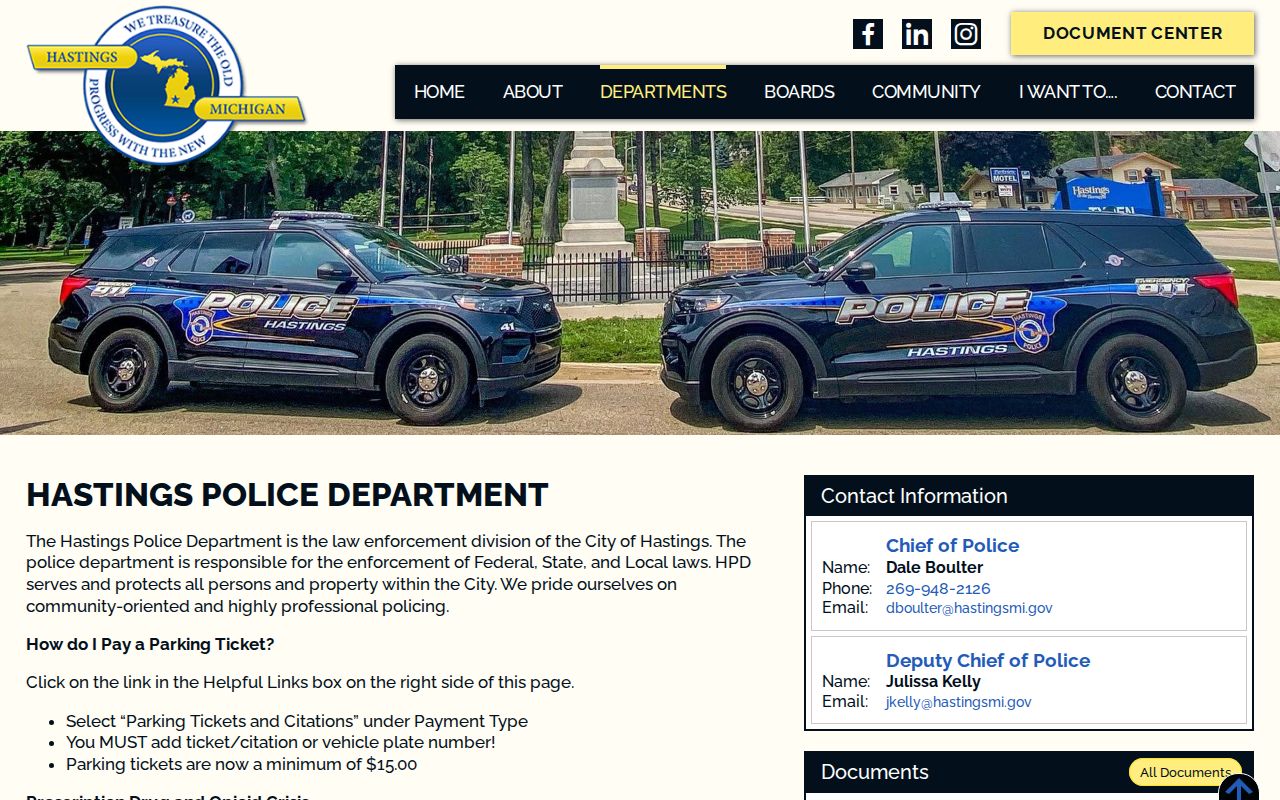
That city source is the right starting point for a Hastings officer’s report, even when later booking and court records are held elsewhere.
No public Hastings arrest database was found. A focused request is more useful than a demand for “everything.” Ask for an identified incident report, supplemental report, arrest sheet, photographs, or body-camera segment as needed. Active investigations, victim details, juvenile information, medical facts, private identifiers, and security material may be withheld or redacted under Michigan law.
From Hastings Report to Case
A city call can create several records in sequence. Hastings Police first documents the response. If an officer arrests someone, the person may be transported to the Barry County jail for identity intake, property inventory, fingerprints, booking photo, screening, charge entry, and bond processing. The prosecutor then decides what to authorize. A filed adult criminal matter begins in 56B District Court, even when the alleged conduct took place inside Hastings.
Event flow: Hastings police report › Barry jail booking › prosecutor review › 56B arraignment › dismissal, district disposition, or felony bindover › 5th Circuit disposition.
The sequence explains timing gaps. An HPD report may be available before MiCOURT shows a case. A booking allegation is not a conviction. Later court events can change the charge or show that it was dismissed. For an accurate Hastings record check, retain the exact case number and read every charge separately.
When Hastings Reports Lack Cases
An HPD report with no MiCOURT match is not necessarily an error. Police create an incident file when they respond and investigate. Prosecutors may still be reviewing the matter, may decline to authorize a charge, or may file under a spelling or identifier different from the one searched. Court entry can also lag a recent arrest. Start by confirming the report number with Hastings Police. Then ask whether the record identifies an arrest date or a court case number. Allow time for a new filing before repeating the D56B search.
If no case was filed, the police report remains an agency record rather than proof of a prosecution. If the case is older, contact the Trial Court clerk because some material may not be digitized. When a search yields several people with the same name, do not pick the closest result by age or address alone. Compare only lawful identifiers from the official records. These checks protect both the searcher and the person named in a Hastings criminal record.
A rejected charge, dismissal, and acquittal are different results. A rejected charge may never form a court case. A dismissal ends a filed count without a conviction on that count. An acquittal is a not-guilty decision. The officer narrative cannot answer which of those later outcomes occurred.
Booking and Arrest Records in Hastings
Hastings does not need a separate city jail search. The Barry County Sheriff’s Office and jail handle county custody at 1212 W. State Street. Its official inmate lookup gateway points to VINELink, a custody-status and notification service rather than a full county booking-history archive. For a person who may still be held, call 269-948-4804. For an existing releasable booking record, use the Sheriff records or FOIA channel.
Keep three terms apart. An arrest record describes police custody. A booking record describes jail intake and detention. A court case records filed charges and their disposition. The incident number helps with HPD; the booking or custody inquiry belongs with the jail; the case number belongs with the clerk. One name can appear in all three, but the files serve different purposes.
Note: A bond amount, booking photograph, or charge label does not prove guilt or predict the final Hastings court result.
Search Hastings Cases in D56B
The 56B District MiCOURT search is the correct city-level court lookup. Search by name or case details, confirm that the court code is D56B, and record the full case number. The public display can include filing date, case type, judge, status, charges, statute, event dates, hearings, disposition, and some financial fields. MiCOURT is chiefly an index. A docket line does not promise a free copy of the underlying complaint, order, or recording.
Older or nondigitized material may require the clerk. Barry Trial Court’s record-request procedure asks for a complete case number or a party name tied to a specific case. A 2025 local administrative order rejects open-ended background checks by court staff and directs requesters to identify the file. If a felony moves after bindover, repeat the search under C05 for the 5th Circuit record.
The Hastings Municipal Court File
There is no separate Hastings municipal criminal court portal. Michigan routes city ordinance, traffic, misdemeanor, arraignment, and preliminary felony work through 56B District Court. Felony trials after bindover belong in 5th Circuit Court. “Municipal court” on a city record search therefore means the county trial-court file connected to a Hastings event, not a distinct city docket.
| Court Name | 56B District Court, with 5th Circuit Court after felony bindover |
|---|---|
| Case Types Heard | City ordinance and traffic matters, misdemeanors, arraignments, and felony preliminary stages |
| Case Lookup Channel | D56B MiCOURT; C05 MiCOURT for transferred felony cases; clerk request for the official file |
| What the Docket Shows | Case number, status, charges, events, hearings, dispositions, and available financial entries |
| Copies & Fees | Request a named file or complete case number; the public form leaves the current copy rate for staff to calculate |
This division matters most during a felony case. The district docket shows the complaint, arraignment, probable-cause conference, examination or waiver, and bindover. The circuit docket then becomes the main file for trial-level proceedings and final sentence.
Hastings Booking Versus Disposition
Records created at different stages can appear to conflict. The police report states what was alleged and observed. The jail entry shows what charge was recorded at intake. The district docket reflects what prosecutors filed. The final disposition tells whether a count ended in conviction, dismissal, acquittal, or another result. None should be substituted for the other.
| Record | Keeper | Best Use |
|---|---|---|
| Incident report | Hastings Police | Officer narrative and event details |
| Booking record | Barry County Jail | Custody, intake charge, bond, and release |
| Court docket | 56B or 5th Circuit clerk | Filed charges, hearings, and final outcome |
| ICHAT result | Michigan State Police | Public reportable statewide criminal history |
Use the date of birth or another lawful identifier when a common name returns several results. Never assume that a name match belongs to the same person without confirmation from the official record.
How Hastings Records Reach the County
Hastings Police retains the city-created narrative, but later steps move into county systems. The Barry jail holds intake and custody material. The Trial Court keeps the district and circuit dockets. Courts and law-enforcement agencies report qualifying events to the Michigan State Police Criminal Justice Information Center, which supplies the public ICHAT product.
Record flow: Hastings Police Department › Barry County jail and Trial Court › Michigan State Police.
ICHAT searches by name, race, sex, and date of birth, with optional middle name. It covers public Michigan criminal history supported by fingerprints and reportable court data. It does not provide a live warrant check, every police contact, juvenile records, federal history, or another state’s files. Use it after the local search, not in place of the local keeper.
For self-review, save the ICHAT response and compare it with the Hastings court judgment. A mismatch may stem from reporting time, a mistaken identity match, or a later set-aside. Michigan uses “set aside” for the process that makes many qualifying convictions nonpublic. Questions about an incorrect city report go to HPD, while disputed state repository data must be addressed through the Michigan State Police process.
Hastings Records at County Altitude
The official City of Hastings source places the city office and public services in their local context.
Hastings is both a city and the county seat, which explains why police, jail, court, and county FOIA records may all describe one local event.
The city had 7,514 residents at the 2020 Census and covers 5.21 square miles. Those figures describe the place, not its conviction rate. Likewise, police incident totals, arrests, filed cases, and convictions are different measures. Compare local public-safety numbers only when the year, geography, and reporting coverage match.
Hastings Record Access Rules
Michigan’s Freedom of Information Act applies to existing public records held by city and county agencies, subject to exemptions. It does not force Hastings Police to create a new report, answer questions, or release protected details. Court records follow court access rules and should be requested from the clerk rather than through general county FOIA. Ask for a defined record, request electronic delivery when practical, and seek a cost estimate if video or extensive redaction may be involved.
Key Statutes:
Michigan Freedom of Information Act, MCL 15.231 declares the state policy favoring public access, subject to legal limits.
MCL 15.235 generally requires an initial response within five business days and permits one extension.
MCL 15.243 lists exemptions, including privacy and qualifying law-enforcement interests.
A denial or redaction should identify its legal basis. For self-review, compare the released city record with the court disposition and seek correction from the office that maintains the disputed information.