
Criminal Court Cases in Barry County
Barry County criminal court cases begin in the 56B District Court. That court handles misdemeanor cases within its authority, traffic matters, arraignments, bail, probable-cause conferences, and preliminary examinations in felony cases. If a felony charge is bound over, the prosecution moves to the 5th Circuit Court for the information, motions, plea or trial, judgment, and sentence. The two courts therefore may hold linked records about one prosecution.
The clerk is the custodian of filed court material. Police reports stay with the investigating agency, and booking records stay with the Barry County Sheriff and jail. The Prosecuting Attorney files charges, but that office is not the keeper of the court case file. Searchers should match the court, court code, and case number before asking for a copy.
Location is part of that choice. The 5th Circuit public counter is on floor 2 of the Historic Barry County Courthouse at 220 W. State Street in Hastings. The 56B District Court is at 206 W. Court Street, Suite 202. Both publish weekday counter hours from 8:00 a.m. to 4:45 p.m., with a 12:30 to 1:30 p.m. lunch closure. The Trial Court main line is 269-945-1400, and callers can confirm the right counter before a trip.
The county’s Trial Court and law-enforcement gateway shows the local court structure. It is useful for checking which office should receive a question.
Barry County's Two Case Searches
MiCOURT uses separate scopes for Barry County. Court code C05 points to the 5th Circuit, while D56B points to the 56B District Court. A district search can show the arraignment and bindover path. The circuit search may then show the later felony file. Looking in only one scope can make a continuing case seem absent.
| Court | Barry County case work | Best use |
|---|---|---|
| 56B District Court | Misdemeanors, arraignments, bail, and preliminary felony stages | New cases and early felony events |
| 5th Circuit Court | Felony trials after bindover and circuit post-judgment work | Felony disposition and sentence |
The official C05 MiCOURT screen is the direct Circuit search. Its county and court code make clear which docket is being queried.
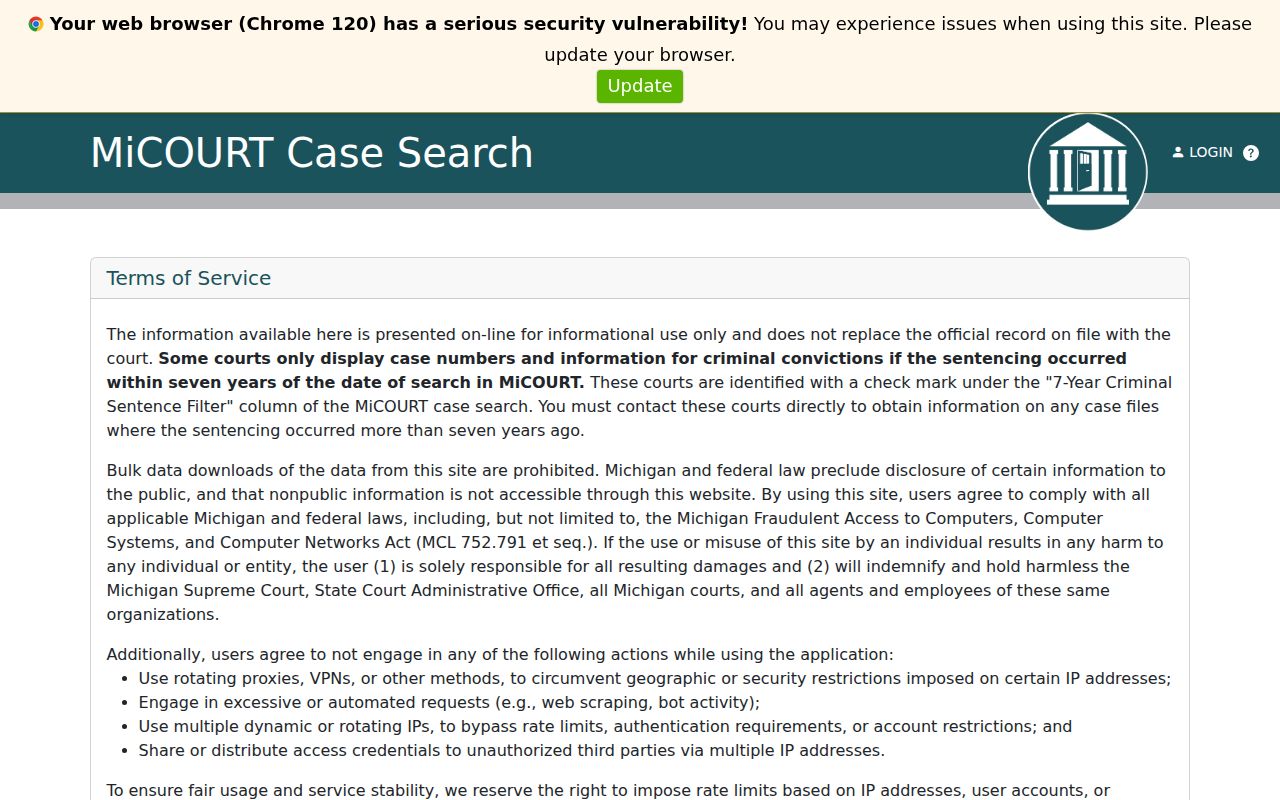
The screen helps users keep a Circuit result distinct from a District file before they request official papers.
Barry County Case Record Searches
Start with the county’s court-record search routing page. Pick the court tied to the event, then search by name or case number. An exact number is strongest because common names can produce unrelated results. MiCOURT is free to search and does not require a public user to register for the index.
- Choose C05 for Circuit criminal matters or D56B for District criminal and early felony proceedings.
- Select a name search or enter the court-specific case number exactly as shown on a notice.
- Add a first name, middle name, or date of birth when the interface permits it and identity needs to be narrowed.
- Open the case and read each charge, event, disposition, and later entry in date order.
- Record the case number, then send a focused copy request to the Barry County Trial Court clerk.
| Field Label | Type | Required | Notes |
|---|---|---|---|
| Court | Search scope | Yes | C05 5th Circuit or D56B 56B District |
| Search Type | Control | Yes | Name or Case Number |
| Last Name/Business Name | Text | For name search | Enter the party surname |
| First and Middle Name | Text | No | Helps narrow common names |
| Date of Birth | Date | Varies | Use an exact date when lawfully known |
| Case Number | Text | For number search | Copy the court-specific number exactly |
Barry Court's Specific-Case Rule
The Barry County Trial Court’s 2025 memorandum rejects open-ended general record checks. Staff need a complete case number or a party name that identifies a specific file. A person who has neither should search the public index first or use the Michigan State Police ICHAT product for a broader state repository result.
The Trial Court record and copy request asks whether the user wants to review the record, obtain copies, order the complete public file, or list specific documents or recordings. The form also has contact fields and court-use fields for approval, denial, copy count, rate, and total. It leaves the current copy rate blank, so the clerk should quote any charge before work begins.
Barry County’s FOIA information page explains the county route for qualifying county records outside the clerk’s court-file process.
The distinction prevents a court-copy request from being sent through a general county records channel that does not hold the judicial file.
Note: A docket entry can identify a document without making that document available as a free download.
What a Criminal Case File Contains
A Barry County court case file is organized around one prosecution. It may show the charging complaint, an information after felony bindover, notices, motions, orders, plea and judgment material, and sentence entries. The register of actions is the dated event list. It is often the fastest way to see whether a hearing occurred, a count changed, or a later order affected public display.
| Case Number & Court | Identifies the file, court code, filing date, case type, judge, and status. |
|---|---|
| Charging Document | States each filed allegation and the cited Michigan law. |
| Docket Entries | Lists filings, orders, hearings, warrants where public, and other events by date. |
| Hearing Dates | May show event type, time, courtroom, and judge. |
| Disposition & Judgment | Shows the result for each count, such as conviction, acquittal, or dismissal. |
| Sentence & Conditions | May list custody, probation, fines, costs, restitution, and related dates. |
Read each count on its own. A dismissed count does not mean the full case was dismissed, and a case can contain both dismissed and convicted counts. The complete official file may also contain papers not visible in the public index.
Reading Barry County Docket Events
Michigan court terms mark the route of the case. An arraignment states charges and rights. A preliminary examination tests probable cause before a felony bindover. The bindover transfers that felony from District to Circuit Court. A disposition is the result of a charge, while the sentence is the sanction imposed after a conviction.
- Complaint
- The sworn charging paper that starts the criminal case.
- Information
- The prosecutor’s Circuit Court charging paper after waiver or bindover.
- Register of actions
- The court’s chronological list of filed and scheduled events.
- Disposition
- The outcome of one charge or the full case.
- Set aside
- Michigan relief that makes a qualifying conviction nonpublic under law.
The Barry County Prosecuting Attorney page identifies the office that authorizes and prosecutes charges.
That office’s role explains why a charging choice appears in the docket, but court copies still come from the clerk.
Criminal Case Stages in Barry County
Once charges are filed, the District Court handles arraignment and sets the early schedule. A misdemeanor may remain there through plea, trial, disposition, and sentence. A felony proceeds through a probable-cause conference and preliminary examination unless that hearing is waived. When probable cause is found or the matter is waived over, the Circuit file takes up the later stages.
Case flow: Charges Filed › Arraignment › Pretrial › Plea or Trial › Disposition › Sentencing
Later events can matter as much as the first result. An appeal, amended judgment, probation action, correction, or set-aside order may change how a Barry County case should be read. Use the newest docket entry and request the signed order when the outcome is unclear.
When Barry Case Documents Are Missing
MiCOURT is primarily an index. A public event line does not guarantee that the underlying PDF can be viewed online. Older or nondigitized records may also require clerk contact. Write down the exact court and case number, identify each paper needed, and ask for electronic copies or a chance to inspect the public file. A narrow request helps staff locate the right material.
Online display limits are not the same as record destruction. Some courts show only case numbers and criminal-conviction information when sentencing occurred within seven years of the search. Nonpublic matters, including juvenile and child-protective cases, mental illness cases, personal-protection matters, and extreme-risk orders, do not appear in the public view.
The Barry County Public Defender page describes the county office that represents qualifying defendants.
Representation and record custody are separate functions, so file requests should remain directed to the clerk.
Barry County's Split Court Campus
A court name matters more than the age or look of the building. Barry County still uses the Historic Courthouse for Circuit work, while the District courtroom and trial-court operations are based in the Courts and Law Building. A person who assumes that every criminal counter sits in the historic building can reach the wrong desk even after finding the right case online.
For Circuit records, the published public counter is on floor 2 at 220 W. State Street. The 56B District Court is nearby at 206 W. Court Street, Suite 202. Both are in Hastings, but they serve different parts of a criminal case. Call the Trial Court first when the docket does not make the counter clear. Security screening, phone rules, parking, language help, and accessibility needs should also be confirmed before travel because the official county pages do not give one combined entry notice for both buildings.
Access Rules for Case Records
Public access in Barry County is subject to Michigan law and court rules. Michigan FOIA states a policy of access to government affairs, but judicial records follow the court’s own access process. Agency records may be withheld or redacted for privacy, active law-enforcement work, victim safety, juvenile information, medical data, personal identifiers, and security interests.
MCL 15.231 states Michigan’s public-access policy, while MCL 15.243 lists exemptions. Neither turns a general FOIA request into an open-ended court record check.
A missing result can mean the wrong court was searched, the case is too new, the event has not been entered, or the record is nonpublic. It does not establish that no file exists. For a related custody event, the Barry County arrest search explains how jail and agency records differ from the court case file.
Identity also needs care. A name-only match is not proof that the file concerns the person being researched. Compare the date of birth or other lawful identifiers in the official record, read the full disposition, and use the signed judgment when a summary line is unclear. If a later set-aside order should have changed public display, ask the sentencing court about its file and use the Michigan State Police correction route for a repository entry that remains wrong.