
Middleville Criminal History Checks
A Middleville event may produce a Sheriff incident report, a Barry jail booking, a D56B court docket, and later a state repository entry. Those files do not appear at the same time and do not state the same facts. Start with the approximate date and place, identify the responding agency, and decide whether the need is for an officer narrative, current custody, a filed charge, or a final disposition.
- Confirm whether the Barry Sheriff’s Middleville Unit, another Sheriff patrol unit, or a different agency handled the event.
- Request the incident or arrest report from the creating law-enforcement agency, using the incident number when possible.
- Call the Barry County jail for current custody and check the official inmate gateway.
- Search D56B MiCOURT, then C05 if a felony was transferred to Circuit Court.
- Use Michigan ICHAT for public reportable statewide history and compare it with the local disposition.
Do not send the same broad request to every office. The village clerk can locate village contracts and administrative records, but the clerk does not become the keeper of a deputy’s police report merely because the Sheriff unit works from Village Hall.
Barry Sheriff’s Middleville Unit
The official village staff page names Sergeant Scott Ware and gives the contracted unit’s direct telephone number, 269-795-9862.

This local presence is the key to Middleville records: deputies work in the village, but their law-enforcement files remain Barry County Sheriff records.
The unit is housed at Village Hall, 100 E. Main Street, P.O. Box 69, Middleville, MI 49333. An official village plan says the Sheriff squad room and command sergeant use about one-third of the renovated hall, and the adopted budget confirms that the agreement is paid from the village General Fund. That arrangement offers a nearby contact without creating a separate village police agency or village arrest database.
Records at the Middleville Police Department
Despite the anchor wording, Middleville has no independent police department. Police records for incidents handled by the contracted unit belong to the Barry County Sheriff. Call the general Sheriff business line at 269-948-4805 when the direct local unit cannot resolve which division holds the report. Give staff the date, location, parties, report number, and the exact item requested.
A focused request might identify an incident report, supplemental narrative, arrest sheet, photographs, or body-camera segment. The Sheriff may redact active-investigation details, protected victim information, juvenile material, medical facts, private identifiers, or security-sensitive content. A Central Dispatch CAD log or 911 recording is separate from the deputy’s narrative and uses Barry County Central Dispatch FOIA.
Who Made the Middleville Report?
Not knowing the arresting unit is a practical obstacle, but it is usually solvable. Start with where the event occurred and who arrived. A vehicle or report number may identify the agency. If unsure, call the Sheriff business line and provide the event date, time, and street. For a traffic crash, Michigan State Police may instead hold the report, and the state Traffic Crash Purchasing System uses a crash number or driver-identifying details.
- Incident report
- The responding agency’s record of the call, observations, interviews, and action.
- CAD record
- The dispatch log showing call handling and unit activity, not the deputy’s full narrative.
- Booking record
- The jail’s identity, charge, bond, custody, and release information after intake.
- Court docket
- The clerk’s chronological record of filed charges, hearings, orders, and disposition.
Ask each keeper only for its own file. That narrows fees and reduces delay caused by a request sent to an office that never possessed the record.
Requesting Middleville Unit Records
A good request begins with a short event description. State that the incident occurred in Middleville, list the approximate date and time, give the street or intersection, and identify the people involved. Add the Sheriff incident number if it is available. Then name the existing item sought, such as the initial incident report, a supplemental narrative, an arrest sheet, photographs, or a defined body-camera segment. Asking for distinct items helps staff search and estimate review work.
The county’s general FOIA route is a fallback for county-held records. A written request may be mailed or delivered to the FOIA Coordinator on floor 3 of the Barry County Courthouse, 220 W. State Street, Hastings, MI 49058; faxed to 269-948-4884; or emailed to bcfoiacoordinator@barrycounty.org. Put “FOIA Request” in the subject or cover line. Include a complete name, address, and phone number or email, along with enough detail to locate the record.
County FOIA is still not the route for a court filing. Once a D56B case exists, use its case number with the Trial Court clerk. For a 911 call or CAD timeline, use Central Dispatch. The separation is useful: a deputy narrative, dispatch timeline, booking sheet, and court docket can be compared without pretending that one is a full copy of the others.
Booking and Arrest Records in Middleville
A deputy who makes an arrest in Middleville generally transports the person to the Barry County jail at 1212 W. State Street in Hastings. The jail intake can include identity checks, property inventory, fingerprints, a booking photograph, health screening, charge entry, classification, and bond processing. Use the jail line, 269-948-4804, for current custody. The county inmate gateway routes users to VINELink for custody status and notification.
VINELink is not a complete Middleville booking archive. For an older releasable booking sheet, charge and bond page, or release record, request the specific existing record through the Sheriff. A booking may appear before a court file. It may also preserve the intake allegation even if prosecutors later amend or reject a charge.
Note: Use 269-948-4804 for jail custody and 269-948-4805 for Sheriff business or report-routing questions.
Middleville Report Versus Barry Booking
The Sheriff report and jail booking may share a person and date, but they answer different questions. The report explains the investigated event. The booking documents admission into custody. The district docket then shows what charge was actually filed, and the final court entry supplies the legal outcome.
| Source | What It Establishes | What It Cannot Establish Alone |
|---|---|---|
| Middleville Unit report | Deputy narrative, event details, investigative steps | Final court outcome |
| Barry jail record | Intake, custody, bond, and release | Guilt or conviction |
| D56B or C05 docket | Filed charges, proceedings, and disposition | Every fact in the police investigation |
| ICHAT | Public reportable Michigan history | Live warrant, same-hour booking, or every police contact |
A strong Middleville criminal record review follows the sequence through disposition. Never infer guilt from an arrest, bond amount, or booking photograph.
The Middleville Municipal Court File
Middleville has no separate municipal criminal court search. The 56B District Court is the local court channel for ordinance and traffic matters, misdemeanors, arraignments, and felony preliminary stages. If a felony is bound over, the 5th Circuit Court becomes the trial-level file. Both courts are part of the Barry County Trial Court system in Hastings.
| Court Name | 56B District Court; 5th Circuit Court for felony proceedings after bindover |
|---|---|
| Case Types Heard | Ordinance and traffic matters, district misdemeanors, arraignments, and felony preliminary proceedings |
| Case Lookup Channel | D56B MiCOURT, followed by C05 MiCOURT when a felony transfers |
| What the Docket Shows | Case number, parties, filed charges, register of actions, hearings, status, and disposition |
| Copies & Fees | Request an identified file from the Trial Court; staff calculates applicable copy charges |
Search results are indexes, not guaranteed document downloads. Record the full case number, read each count separately, and ask the clerk for the complaint, order, judgment, or recording needed.
D56B Is Middleville’s Court Search
Use the D56B MiCOURT portal for a new Middleville case. Search by name and lawful identifiers, then confirm the filing date, court code, and case number. The register of actions is the chronological docket. It may show authorization, arraignment, probable-cause conference, preliminary examination or waiver, plea, trial, sentence, probation, or warrant events.
For older or nondigitized files, contact the clerk at 269-945-1400. Barry Trial Court asks for a complete case number or party name tied to a specific case. It does not conduct open-ended criminal background checks. If the district docket shows bindover, switch to the C05 Circuit search because later felony events will be filed there.
How Middleville Records Reach the County
The local Sheriff unit creates its report as part of the county law-enforcement system. Custody moves to the Barry jail. Adult charges start in 56B District Court, and a felony may move to 5th Circuit. Qualifying fingerprint and disposition data then flow to the Michigan State Police Criminal Justice Information Center.
Record flow: Barry Sheriff’s Middleville Unit › Barry County jail and Trial Court › Michigan State Police.
The public ICHAT name search offers a statewide view of reportable Michigan history. It does not replace the deputy’s narrative, reveal a live warrant, or cover every local contact. Names can also collide. Compare date of birth and other lawful identifiers, then confirm any result with the official case file.
ICHAT is also not the place to resolve an urgent warrant question. A warrant may be sealed, may arise from a court event not yet reflected in the repository, or may not be part of the public ICHAT product at all. A person addressing their own possible warrant should contact the court or an attorney through official channels rather than rely on a missing name-search result.
Village FOIA or Sheriff FOIA?
The village’s FOIA convenience form is a real public access channel for records held by Middleville.
Use it for village administrative records, such as local contracts or government documents, rather than as a substitute for the Sheriff’s police-report process.
The village FOIA administrator is Rhonda Van Polen at rvanpolen@villageofmiddleville.org. Village Hall is open Monday through Thursday, 8:00 a.m.–5:00 p.m., and Friday, 8:00 a.m.–noon. A request to the wrong keeper can only produce a referral or a statement that the village lacks the record. Ask the Sheriff for deputy-created law-enforcement files and the Trial Court for judicial records.
Middleville Hall’s Dual Role
The official Village of Middleville source depicts the hall that houses both village services and the contracted Sheriff unit.
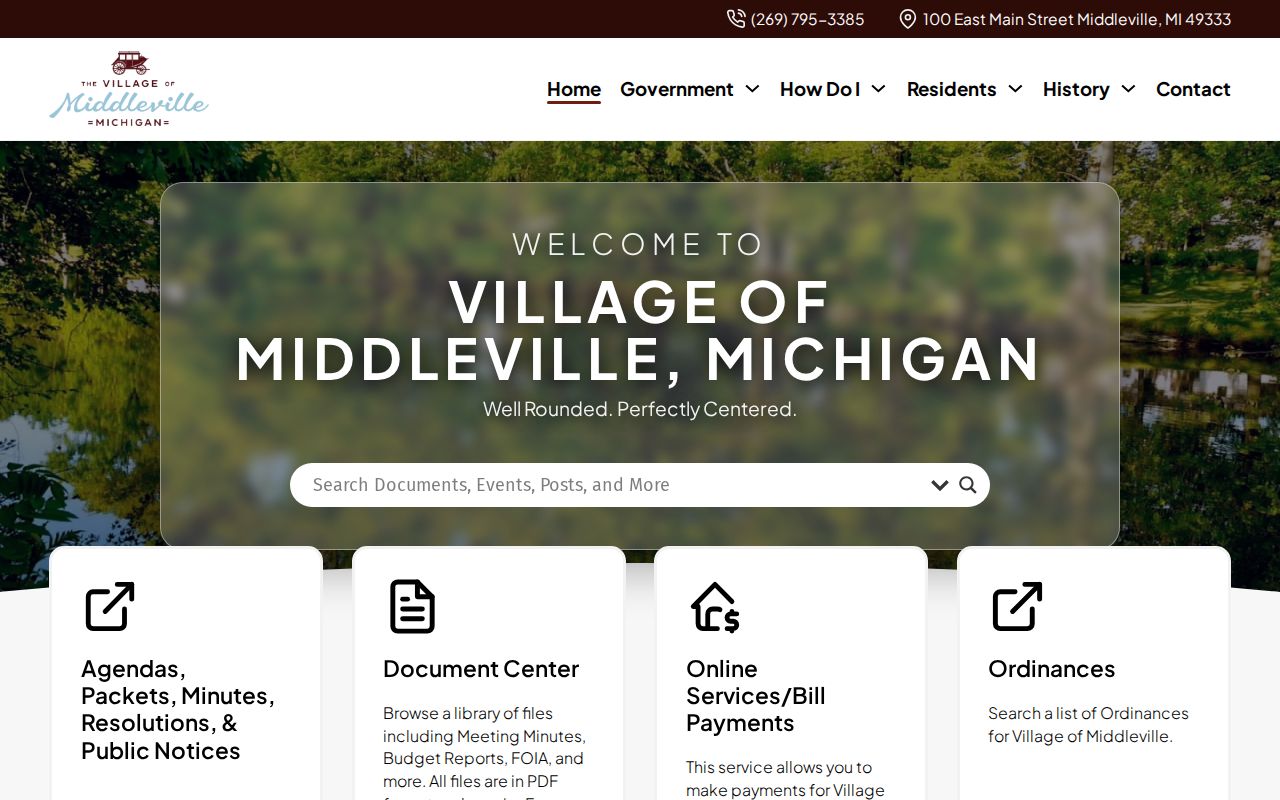
Sharing a building does not merge record custody: village files stay with village staff, while law-enforcement reports stay with the Sheriff.
Middleville had 4,295 residents at the 2020 Census. Its history dates settlement to 1834 and incorporation to 1867. Historic accounts of village policing, including Marshal and Sheriff James Gibbs’s 1879 death after an arrest, belong to the town’s history. They do not describe the present records system. Today’s useful distinction is the formal Sheriff contract.
Middleville Record Access Rules
Michigan FOIA gives access to existing agency records, subject to statutory exemptions. A clear request describes the agency, date, place, incident number, people involved, and exact record sought. It does not require an office to create a new report. Courts follow their own access rules, so court filings go to the Trial Court clerk rather than village or county administrative FOIA.
Key Statutes:
Michigan Freedom of Information Act, MCL 15.231 states Michigan’s policy of public access, within legal limits.
MCL 15.235 generally sets a five-business-day initial response period and allows one extension.
MCL 15.243 permits withholding of protected privacy and qualifying law-enforcement information.
Ask for electronic delivery and a cost estimate when a request may require extensive review. When correcting your own record, contact the office that created and maintains the disputed entry.